
How to Perform Istikhara for Marriage: A Step-by-Step Guide
Choosing a life partner is one of the biggest decisions a Muslim will ever make. It affects not just your own life, but the lives of your entire family for generations to come. This is exactly why the Prophet Muhammad (peace be upon him) taught us Istikhara a special prayer for seeking Allah’s guidance before any major decision, especially marriage.
If you’re confused about a marriage proposal, unsure whether a particular rishta is right for you, or simply want Allah’s blessing before moving forward, this guide will walk you through exactly how to perform Istikhara for marriage, what to expect afterward, and how to interpret the signs you receive.
What Is Istikhara and Why Is It Important for Marriage?
Istikhara literally means “seeking the best” or “seeking guidance.” It is a two-rakat optional prayer followed by a specific dua, through which a believer asks Allah to guide them toward whatever is best for them whether that’s a marriage proposal, a job opportunity, or any other significant life choice.
Marriage decisions carry immense weight in Islam. Unlike many life choices that can be reversed easily, marriage is a lifelong commitment (nikah) built on trust, compatibility, and Allah’s blessing. This is precisely why istikhara for marriage is one of the most commonly performed forms of this prayer. When a proposal comes your way, or when you’re evaluating multiple options, Istikhara removes the confusion and places the outcome in Allah’s hands rather than relying purely on your own limited judgment or family pressure.
Many people search for guidance on this topic because they feel torn between two proposals, worried about compatibility, or pressured by family members to decide quickly. Istikhara offers a peaceful, spiritually grounded way to move forward with confidence.
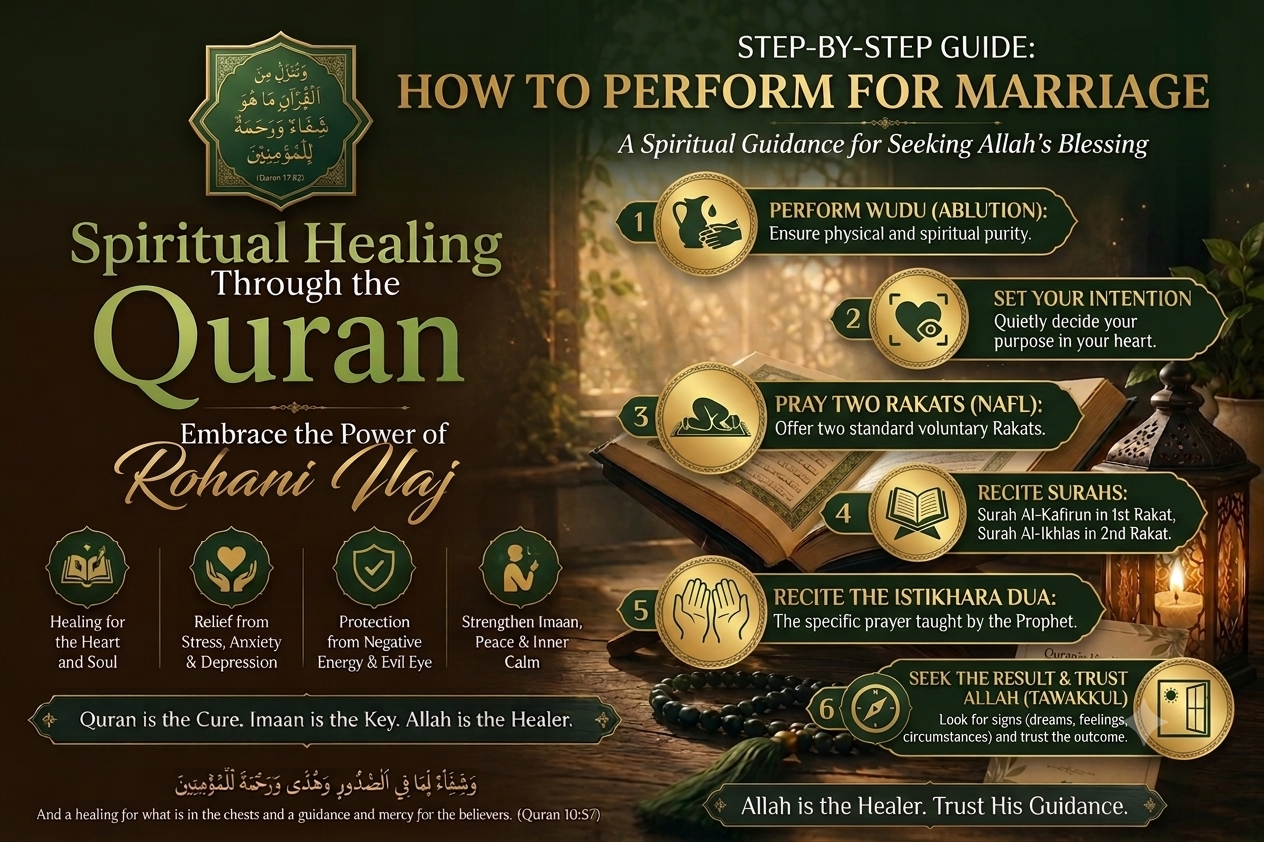
Step-by-Step Guide: How to Perform Istikhara for Marriage
Performing Istikhara correctly involves both the physical prayer and the sincerity of your intention (niyyah). Here is the complete process:
Step 1: Make Wudu (Ablution)
Before starting any prayer, ensure you are in a state of cleanliness. Perform wudu as you would before any regular Salah.
Step 2: Set Your Intention (Niyyah)
Quietly intend in your heart that you are performing Istikhara specifically regarding the marriage proposal or decision in front of you. You don’t need to say this out loud Allah knows what is in your heart.
Step 3: Pray Two Rakats (Nafl Prayer)
Istikhara begins with two voluntary (nafl) rakats, performed just like any other two-rakat prayer:
- In the first rakat, after reciting Surah Al-Fatiha, it is preferred to recite Surah Al-Kafirun.
- In the second rakat, after Surah Al-Fatiha, recite Surah Al-Ikhlas.
This is a recommended practice, though reciting any other surahs you know well is also acceptable if you’re not confident with these.
Step 4: Recite the Istikhara Dua
After completing the two rakats and finishing with the tasleem (ending the prayer), recite the specific Dua-e-Istikhara. This dua, taught by the Prophet Muhammad (peace be upon him), asks Allah to grant you the marriage proposal if it is good for you in this life and the next, and to keep it away from you if it is not replacing it with something better.
The dua in translation carries this meaning:
“O Allah, I seek Your guidance by virtue of Your knowledge, and I seek ability by virtue of Your power, and I ask You of Your great bounty. You have power, I have none. You know, I know not. You are the Knower of hidden things. O Allah, if in Your knowledge, this marriage is good for me in my religion, my livelihood, and the outcome of my affairs then ordain it for me, make it easy for me, and bless it for me. And if in Your knowledge, this marriage is bad for me in my religion, my livelihood, and the outcome of my affairs then turn it away from me, and turn me away from it, and ordain for me the good wherever it may be, and make me content with it.”
It’s important to mention the specific matter (in this case, the marriage proposal or the person’s name) silently in your heart while reciting this dua.
Step 5: Repeat if Necessary
If you don’t feel a clear sense of direction after the first attempt, it is permissible to repeat the Istikhara prayer over multiple days commonly for three, five, or seven consecutive days until you feel a sense of clarity or peace about the decision.
Step 6: Proceed with Trust (Tawakkul)
After performing Istikhara, the most important step is to place your trust in Allah’s decision. Continue moving forward with practical steps (talking to your family, meeting the other party if culturally appropriate) while remaining spiritually open to whichever direction feels right.
Common Misconceptions About Istikhara for Marriage
Many people misunderstand how Istikhara is supposed to work, which leads to unnecessary confusion or anxiety. Let’s clear up a few common misconceptions:
Misconception 1: You Must See a Dream
One of the most widespread myths is that Istikhara only “works” if you see a dream that night. In reality, Istikhara guidance can come in many forms through a dream, through a sudden feeling of ease or discomfort about the decision, through circumstances changing naturally (the proposal falling through or moving forward smoothly), or simply through a growing sense of clarity over a few days.
Misconception 2: A Bad Dream Means the Person Is Bad
Dream interpretation in the context of Istikhara is not always literal. A dream involving darkness, black colors, or unsettling imagery is often interpreted as a sign of discouragement, but this should be considered alongside your own feelings and practical circumstances not in isolation. This is one of the main reasons people seek guidance from a knowledgeable Rohani Ilaaj practitioner, who can help interpret signs within proper Islamic context rather than random guesswork.
Misconception 3: You Need to Fall Asleep for It to Work
Istikhara doesn’t require sleep or a dream at all. Many people receive their answer simply through a growing sense of ease or unease as days pass, without any dream occurring.
Misconception 4: Only One Istikhara Is Allowed
There’s no restriction on how many times you can perform Istikhara for the same matter. If clarity doesn’t come immediately, continuing the prayer over several days is completely acceptable and often recommended.
Understanding the Signs After Istikhara
Once you’ve performed Istikhara for marriage, here’s what people commonly report as signs of guidance:
Signs of a positive outcome:
- A growing sense of peace, comfort, or ease about the decision
- Dreams involving light, greenery, white colors, water, or generally pleasant imagery
- Circumstances aligning smoothly (families agreeing quickly, communication going well)
- A feeling of excitement or contentment when thinking about the proposal
Signs of discouragement:
- A persistent feeling of unease, heaviness, or anxiety about the decision
- Dreams involving darkness, fire, falling, or distressing imagery
- Circumstances repeatedly falling apart despite genuine effort
- A growing sense of doubt that doesn’t go away with time
It’s worth noting that these signs should never be interpreted in isolation. Combining spiritual guidance with practical wisdom family input, compatibility, deen, and character of the prospective partner gives a much clearer overall picture.
When Should You Perform Istikhara for Marriage?
The best time to perform Istikhara is once you have a specific proposal or decision in front of you not as a vague, general prayer without a concrete matter in mind. Many scholars recommend performing it:
- After receiving a formal marriage proposal
- Before responding with a final “yes” or “no”
- When torn between multiple proposals
- Before finalizing the nikah date, if last-minute doubts arise
Avoid performing Istikhara out of pure anxiety or repeatedly without allowing enough time between attempts for genuine reflection. A common approach is performing it consistently for three to seven nights, ideally before sleeping, so you have time to notice your dreams or feelings upon waking.
What If You Don’t Get a Clear Answer?
It’s completely normal to feel unclear even after multiple attempts. In such cases:
- Continue practical steps. Keep gathering information about the person and situation through halal means speaking with family, mutual acquaintances, or meeting in an appropriate setting.
- Consult trusted people. Speak with parents, siblings, or a trusted elder who knows both families.
- Seek scholarly or spiritual guidance. If you remain confused, consulting an experienced Rohani Ilaaj practitioner can help you understand any lingering spiritual blockages (bandish) that may be clouding your clarity, or help interpret signs you may have overlooked.
- Make dua for patience. Sometimes the absence of a clear sign is itself a sign to wait a little longer before deciding.
The Role of Spiritual Guidance Alongside Istikhara
While Istikhara is a personal act of worship, many people going through a difficult marriage decision also seek additional spiritual support particularly if they suspect external spiritual interference (such as black magic or bandish) is affecting their clarity or the proposal itself. If you find that a proposal keeps falling through unexpectedly, or you experience unusual resistance despite everyone’s best efforts, it may be worth exploring whether a spiritual blockage is at play.
At Roohani Elaj UK, our experienced practitioners combine authentic Istikhara guidance with broader Rohani Ilaaj support helping you not only interpret your Istikhara signs correctly, but also address any underlying spiritual obstacles standing between you and a blessed marriage.
Final Thoughts
Istikhara for marriage is one of the most beautiful practices in Islam a direct, personal conversation with Allah about one of life’s most important decisions. It removes the burden of guessing and places your trust where it belongs. Whether you receive a dream, a feeling, or simply growing clarity over time, remember that the goal of Istikhara isn’t to predict the future it’s to align your heart with what Allah knows is best for you, even when that differs from what you initially wanted.
If you’re currently struggling to interpret your Istikhara signs, or feel that something beyond your control is affecting your marriage proposal, don’t hesitate to reach out for professional, faith-based guidance.
6. FAQ Section
Q1: How many days should I perform Istikhara for marriage? There is no fixed number, but many scholars recommend performing it for three to seven consecutive nights if clarity doesn’t come after the first attempt. Consistency and sincerity matter more than the exact number of days.
Q2: Can I perform Istikhara without seeing a dream? Yes. Istikhara guidance often comes through a growing feeling of ease or discomfort rather than a literal dream. Many people never see a dream at all and still receive clear guidance through their circumstances and emotions.
Q3: What does it mean if I see black or dark colors in my Istikhara dream? Dark or unsettling imagery is generally considered a sign of discouragement, but it should be considered alongside your own feelings and practical circumstances rather than interpreted alone. Consulting a knowledgeable practitioner can help provide proper context.
Q4: Can I do Istikhara for someone else, like my son or daughter? Yes, parents commonly perform Istikhara on behalf of their children regarding a marriage proposal, especially when the child is comfortable with their parents’ involvement in the decision.
Q5: What should I do if I keep getting mixed or unclear signs? Continue practical steps like gathering information and consulting trusted family members, and consider repeating the Istikhara prayer for a few more nights. If confusion persists, seeking guidance from an experienced Rohani Ilaaj practitioner can help identify whether a spiritual blockage is affecting your clarity.