
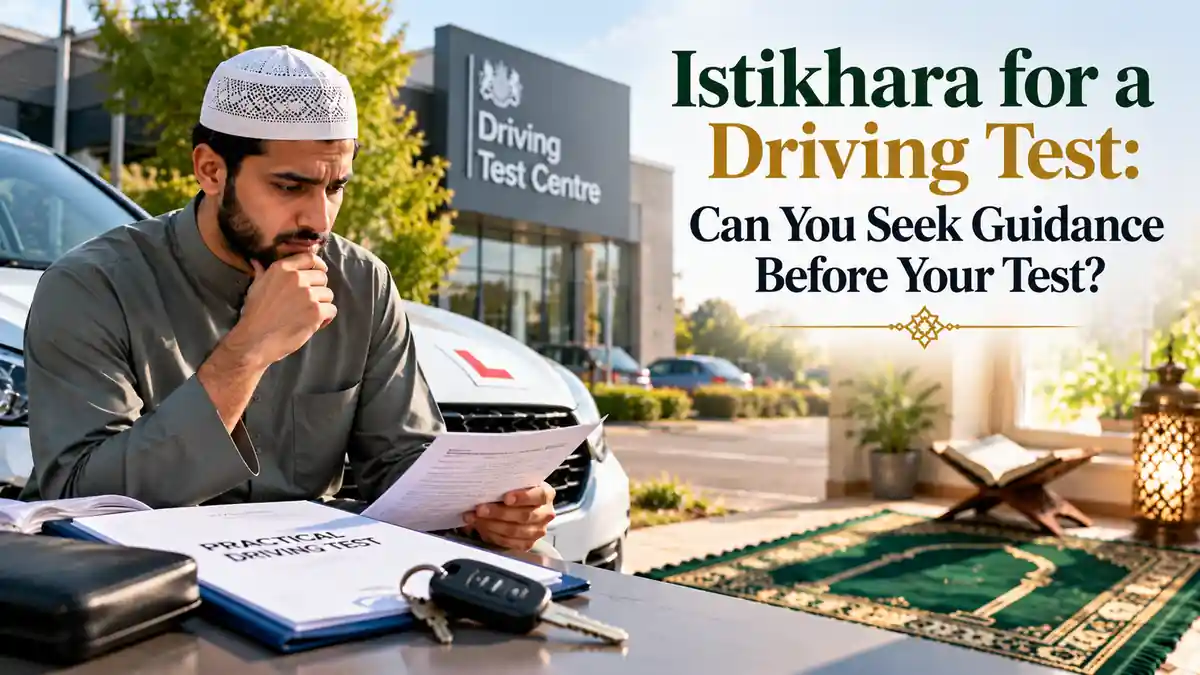
Preparing for a driving test can bring a mixture of excitement, nervousness and uncertainty. You may have spent weeks or months practising, and as your test date approaches, you might wonder whether you should perform Istikhara before taking your driving test.
Istikhara for a driving test is a topic some Muslims explore when seeking Allah’s guidance before an important personal milestone. However, it is important to understand the purpose of Istikhara correctly. It is a prayer for seeking Allah’s guidance when making a decision, not a guaranteed method of predicting whether you will pass or fail.
For Muslims in the UK, spiritual preparation can sit alongside practical driving preparation. This guide explains when Istikhara may be relevant, how to approach the prayer, what it does not guarantee, and how to prepare responsibly for your driving test.
What Is Istikhara in Islam?
Istikhara is an Islamic prayer through which a Muslim asks Allah to guide them towards what is good when facing a decision.
The Prophet Muhammad (peace and blessings be upon him) taught his companions how to perform Istikhara. In Sahih al-Bukhari 6382, Jabir ibn Abdullah (may Allah be pleased with him) reports that the Prophet taught two rak’ahs of voluntary prayer and a supplication asking Allah to decree what is good.
You can read the narration and supplication in Sahih al-Bukhari 6382.
Istikhara is relevant when you are considering a matter and want to seek Allah’s guidance. It should not be confused with fortune-telling or a method for obtaining guaranteed information about future events.
For example, someone might perform Istikhara when deciding whether to accept a job offer, move to a different area or proceed with an important commitment.
A driving test is slightly different: if you have already decided to take your test and simply want to know whether you will pass, Istikhara should not be treated as a way to predict that result. If you are facing a genuine decision about whether to proceed, postpone or make another choice, you can seek appropriate Islamic guidance about your circumstances.
Can You Perform Istikhara Before a Driving Test?
A Muslim may seek Allah’s help and make dua before an important driving test. Whether Salat al-Istikhara is appropriate depends on the nature of the matter you are considering.
It is useful to distinguish between seeking guidance about a decision and asking for a guaranteed outcome.
For example, you may be deciding:
- Whether you are sufficiently prepared to take your test on the booked date.
- Whether to proceed with the test or postpone it because of a genuine concern.
- Whether to book additional lessons before taking the test.
- Whether a particular driving-related decision is right for your circumstances.
If you are genuinely uncertain about a decision, you may consider Istikhara in accordance with its established purpose.
If your only question is whether you will pass, Istikhara should not be treated as a prediction of the examiner’s decision. You can still make dua for ease, confidence, safety and the ability to demonstrate what you have learned.
How to Perform Istikhara When Facing a Driving-Test Decision
The method of Salat al-Istikhara is described in Sahih al-Bukhari 6382. The following steps summarise the established approach.
Step 1: Clarify the Decision
First, identify the decision for which you are seeking guidance.
For example, you might be uncertain whether to proceed with your scheduled test or postpone it because you do not feel adequately prepared.
Be specific about the matter. Wanting to know a future result is not the same as seeking guidance about a decision.
Step 2: Offer Two Rak’ahs of Voluntary Prayer
The hadith describes offering two rak’ahs of voluntary prayer, separate from the obligatory prayer.
Approach the prayer sincerely and ask Allah to guide you towards what is good in the matter you are considering.
Step 3: Recite the Istikhara Supplication
After the prayer, recite the supplication taught by the Prophet Muhammad (peace and blessings be upon him).
The dua asks Allah for what is good through His knowledge and power. It also asks that a harmful matter be turned away and that what is good be granted instead.
The full supplication is available in Sahih al-Bukhari 6382.
Step 4: Continue to Assess Your Situation
After performing Istikhara, consider the practical circumstances surrounding your decision.
If you are unsure whether you are ready for your test, speak to your driving instructor, review your performance during lessons and assess whether you can drive safely without prompting.
Do not assume that you must receive a dream, colour or unusual sign before making a decision. Istikhara should be understood as a prayer for guidance rather than a guaranteed prediction of the future.
For more information about the prayer itself, read our guide to Istikhara.
Can Istikhara Guarantee That You Will Pass Your Driving Test?
No. Istikhara should not be presented as a guarantee that you will pass your driving test.
The result depends on your driving ability, your preparation, the conditions during the test and whether you demonstrate the required standard of safe driving.
The UK government’s official guidance on car driving tests explains that candidates must demonstrate safe driving in different road and traffic conditions and show that they know the Highway Code through their driving.
Prayer and practical preparation serve different purposes. You can seek Allah’s help while continuing to practise, address weaknesses and follow the requirements of the driving test.
Avoid anyone who claims that a particular prayer or spiritual service can guarantee a driving-test pass. Such a claim should not be treated as an established teaching of Istikhara.
How to Prepare Practically for a UK Driving Test
Spiritual preparation can be meaningful to you, but it should accompany practical preparation rather than replace it.
1. Practise With a Qualified Instructor
Work with an appropriately qualified driving instructor and discuss the areas where you need improvement.
These may include observations, mirror checks, junctions, roundabouts, manoeuvres, speed management, independent driving and responding safely to other road users.
Your instructor can help you assess whether you are consistently demonstrating the skills required for the test.
2. Review Your Weak Areas
Rather than practising only the skills you already perform confidently, focus on the areas where you make repeated mistakes.
Ask your instructor to explain what went wrong, what the correct response should be and how you can improve.
Use practice sessions to build safe and consistent driving habits instead of relying on last-minute preparation.
3. Check Your Test Requirements in Advance
Make sure you know what you need to bring and what is expected on the day.
The UK government’s driving-test checklist explains that candidates must bring the appropriate driving licence and a suitable car. A theory-test pass certificate is needed if applicable and available, although the examiner can check the theory-test pass electronically.
If you plan to use your own car, review the official rules for using your own car for the driving test.
Checking these requirements in advance can help you avoid preventable problems on test day.
4. Get Enough Rest
Try to arrive rested and give yourself sufficient time to reach the test centre.
Rushing, missing documents or arriving already stressed can make the experience more difficult. Plan your journey and organise the necessary items beforehand.
5. Manage Nervousness Sensibly
It is normal to feel nervous before an important test.
Slow breathing, adequate sleep, realistic expectations and a familiar preparation routine may help you feel more settled. If anxiety is significantly affecting your ability to drive safely, discuss it with your instructor and consider whether additional preparation or appropriate support would help.
How Can You Combine Dua With Driving-Test Preparation?
A Muslim can make dua before a driving test while also preparing responsibly.
You may ask Allah for ease, calmness, beneficial knowledge, safe driving and the ability to demonstrate your skills clearly.
You can make a personal supplication in your own words. For example:
“O Allah, grant me calmness and clarity, help me use the knowledge and skills I have learned, and guide me towards what is good.”
This is an example of personal dua, not a specific prophetic supplication or a formula that guarantees success.
You can also remind yourself that your responsibility is to prepare, drive safely and respond appropriately during the test. The outcome is not something that can be guaranteed in advance.
If you are facing a genuine decision and want to understand the religious guidance surrounding it, you may seek advice from a qualified Islamic scholar or explore appropriate online Istikhara guidance. Such guidance should not be confused with a promise of passing your test.
What Should You Do After Istikhara?
After performing Istikhara about a genuine decision, continue to consider your circumstances and take reasonable steps.
If You Decide to Proceed With the Test
Prepare carefully, follow your instructor’s advice, check the official requirements and approach the test with realistic expectations.
Do not assume that performing Istikhara means you no longer need to practise or address areas of weakness.
If You Are Unsure Whether You Are Ready
Review your recent driving performance and ask your instructor for an honest assessment.
If you are considering postponement, understand the relevant booking rules and any practical consequences before making a decision.
If You Do Not Pass
Not passing a driving test does not prove that your Istikhara was negative or that your prayer was not accepted.
Review the feedback provided after the test, identify the areas that need improvement and arrange further practice before deciding when to take another test.
You can continue to make dua and seek Allah’s help while learning from the experience.
If You Pass
Passing is an important achievement, but it does not mean that every future driving situation will be easy or risk-free.
Continue to drive responsibly, follow road rules and build experience gradually.
Common Misconceptions About Istikhara for Driving Tests
Does Istikhara Tell Me Whether I Will Pass?
Istikhara is a prayer for seeking guidance in a decision, not a guaranteed method of predicting a driving-test result.
Do I Need to See a Dream Before My Test?
The established Istikhara narration does not require you to receive a particular dream before making a decision. Do not treat dreams or colours as automatic proof of a future outcome.
Should I Stop Practising After Performing Istikhara?
No. Prayer does not replace driving lessons, practical preparation or the responsibility to drive safely.
Is Feeling Confident a Guarantee of Passing?
No. Confidence may help you approach the test calmly, but the result depends on your performance against the required standard.
Can I Make Dua Even If I Do Not Perform Istikhara?
Yes. General dua is distinct from the specific Istikhara prayer. You may ask Allah for ease, patience, confidence and safe driving without treating Istikhara as a required ritual for every test.
Does Failing Mean That Istikhara Was Negative?
No. A failed test does not establish that your Istikhara was negative. Review your performance and use the feedback to improve your driving.
Frequently Asked Questions
Can I do Istikhara before my driving test?
You may seek Allah’s help through dua before your test. Istikhara is intended for seeking guidance about a decision, so consider whether you are facing a genuine choice, such as whether to proceed or postpone, rather than treating it as a way to predict the result.
Is there a special Istikhara dua for passing a driving test?
The established Istikhara supplication is not a separate formula for passing a driving test. It is a dua for seeking Allah’s guidance in a matter. You can also make personal dua asking Allah for ease, calmness and safe driving.
Can Istikhara guarantee that I will pass?
No. Istikhara should not be treated as a guarantee of passing. Prepare properly, follow the official requirements and demonstrate safe driving during your test.
Should I perform Istikhara if I am thinking about postponing my test?
If you are genuinely uncertain about whether to proceed or postpone, you may seek Allah’s guidance through Istikhara. Also assess your driving readiness, consult your instructor and review the practical implications of changing your booking.
What should I do if I feel nervous before my driving test?
Prepare in advance, get adequate rest, organise your documents and discuss your concerns with your instructor. You can make dua for calmness and ease while using practical strategies to manage your nerves.
What should I do after failing my driving test?
Review the feedback, identify the skills you need to improve and arrange further practice. Failing does not prove that Istikhara was negative or that you should give up.
Where can I learn more about Istikhara?
You can read our Istikhara guide for further information about the prayer and its purpose. For a specific religious ruling, consult a qualified Islamic scholar.
Conclusion: Seek Allah’s Guidance and Prepare Responsibly
Preparing for a driving test can be an important milestone, and it is understandable to seek Allah’s help before taking it.
Istikhara is a prayer for seeking guidance when making a decision. It should not be treated as a guaranteed way to predict whether you will pass your driving test.
If you are facing a genuine decision about whether to proceed, postpone or take another step, consider the matter carefully and seek appropriate guidance. Make dua, practise consistently, follow official requirements and listen to your driving instructor’s advice.
Approach your test with faith, preparation and realistic expectations. You can trust Allah while also taking responsibility for your learning, safety and decisions.